




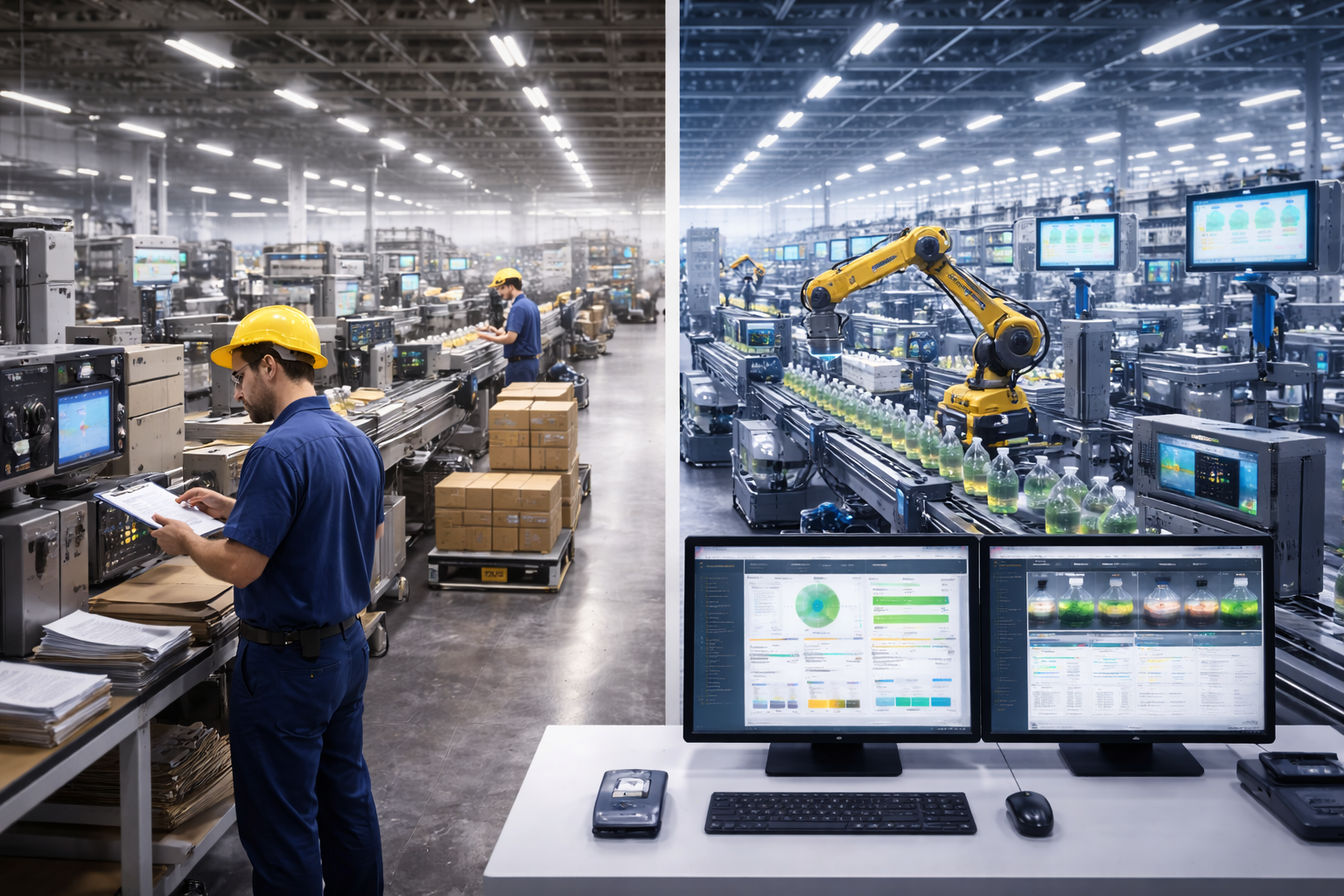
Smart Manufacturing vs Traditional Manufacturing | The Shift to Industry 4.0
Smart Manufacturing vs Traditional Manufacturing – A Fundamental Industry 4.0 Shift
Manufacturing is undergoing a major transformation. The transition from traditional manufacturing to smart manufacturing represents a fundamental shift in how factories operate, make decisions, and manage quality and efficiency.
With the rise of Industry 4.0, manufacturers are moving away from manual, disconnected processes toward digitally connected, data-driven production environments powered by MES, machine vision, automation, and real-time analytics.
Ejabi for Reliable Applications supports this transformation by delivering integrated smart manufacturing solutions that connect shop floor operations with enterprise systems.
What Is Traditional Manufacturing?
Traditional manufacturing relies heavily on:
- Manual data collection
- Standalone machines
- Paper-based work orders
- End-of-line quality inspection
- Reactive decision-making
In this model, production data is often delayed, incomplete, or inaccurate, making it difficult to detect problems early or optimize performance.
What Is Smart Manufacturing?
Smart manufacturing is a core concept of Industry 4.0, where production systems are digitally connected and continuously optimized using real-time data.
Smart manufacturing is characterized by:
- Real-time production monitoring
- MES-driven execution and control
- Automated quality inspection
- Machine-to-system connectivity
- Data-driven decision-making
Quality, efficiency, and traceability are managed as part of the production process—not after it.
Key Differences Between Smart and Traditional Manufacturing
AreaTraditional ManufacturingSmart ManufacturingData CollectionManual / DelayedReal-time / AutomatedQuality ControlEnd-of-line inspectionIn-line, real-time inspectionSystem IntegrationDisconnected systemsMES, inspection, RFID integratedDecision MakingReactivePredictive and proactiveTraceabilityLimitedFull batch & unit-level traceability
The Role of MES in Smart Manufacturing
A Manufacturing Execution System (MES) is the backbone of smart manufacturing.
MES enables:
- Real-time work order execution
- Batch and lot tracking
- Quality data collection
- Operator guidance
- Production performance analysis
By integrating MES with inspection systems and automation, manufacturers gain full visibility and control over shop floor operations.
Quality Control: From Inspection to Intelligence
In traditional manufacturing, quality issues are often discovered too late.
In smart manufacturing, machine vision inspection systems operate in real time and feed results directly into MES.
This enables:
- Immediate defect detection
- Automated rejection and escalation
- Closed-loop quality control
- Continuous process improvement
Quality becomes an active, intelligent function.
Why Manufacturers Are Moving to Smart Manufacturing
Manufacturers adopt smart manufacturing to:
- Improve production efficiency
- Reduce defects and rework
- Increase product consistency
- Achieve full traceability
- Support regulatory compliance
- Enable data-driven optimization
Smart manufacturing is no longer a competitive advantage—it is becoming a necessity.
Transitioning from Traditional to Smart Manufacturing
The shift does not happen overnight. Successful transformation typically includes:
- MES implementation
- Integration of inspection systems
- Shop floor connectivity
- Gradual automation
- Data standardization and analytics
Ejabi helps manufacturers transition step by step with scalable, future-ready architectures.
Why Choose Ejabi for Reliable Applications?
Ejabi delivers smart manufacturing solutions by combining:
- MES & shop floor systems
- Machine vision inspection
- RFID and traceability
- Industry 4.0 integration expertise
We help manufacturers move from reactive operations to intelligent, connected production environments.
The Future Belongs to Smart Manufacturing
Manufacturers that continue to rely on traditional methods risk inefficiency, quality issues, and limited visibility. Smart manufacturing provides the foundation for resilient, scalable, and competitive production operations.
Ejabi for Reliable Applications supports organizations on their journey toward Industry 4.0 and smart manufacturing excellence.